

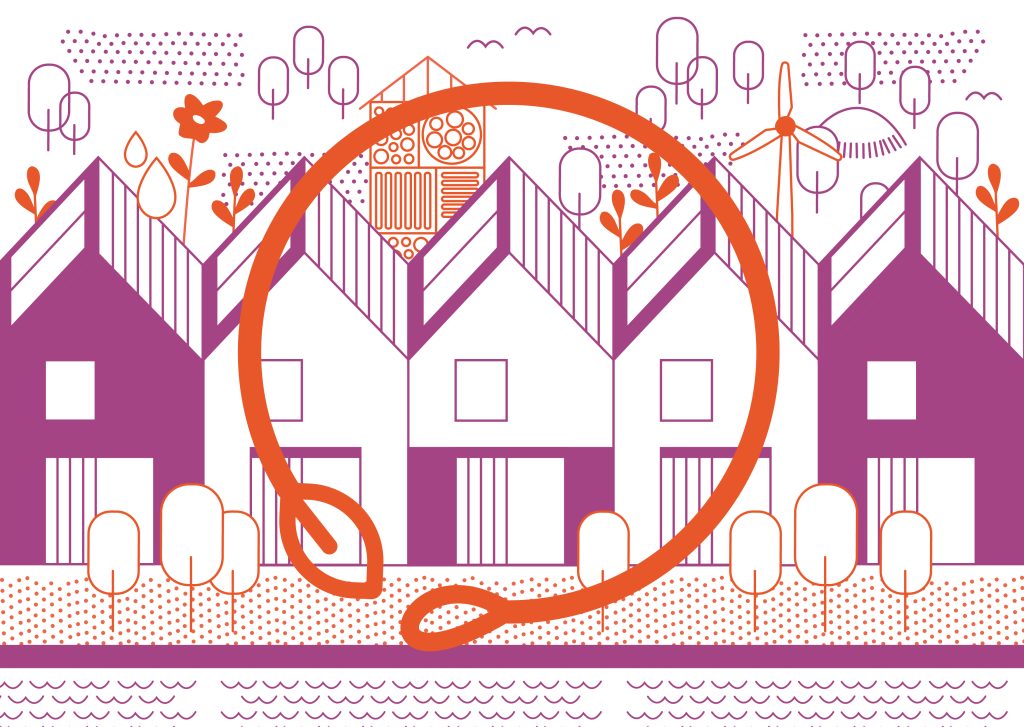
Vision
Design for long-term environmental performance, circularity (reuse and recycle principles), and resilience. Proactively respond to the climate challenge – balancing ambition and practical delivery by promoting use of sustainable materials, energy efficiency and protection of our natural environment and resources.
Expectations
These expectations outline what good looks like. They are not in a set order of priority.
- Design to measurable sustainability standards (e.g. BREEAM, LETI, RIBA, Home Quality Mark) while encouraging Kent-specific innovation.
- Embed circular economy thinking: reuse, recycle, minimise waste and plan for adaptable buildings that can be disassembled.
- Consider whole-life carbon, not just operational carbon, prioritise reuse of Kent’s many existing empty buildings.
- Promote compact, efficient, low-carbon design at every scale of development, reducing over-engineering and overuse of limited natural resources.
- Prioritise local, low-carbon materials. Developers should evidence sustainability credentials transparently.
- Support clean, renewable energy infrastructure tailored to place, for example, solar, heat pumps and EV charging.
- Embed water efficiency into building design, optimising consumption in homes, public buildings and spaces.
- Design for climate resilience: ensuring places can withstand drought, overheating and flooding, prioritising passive measures and nature-based solutions.
- Protect natural resources such as trees, soil and ecosystems for carbon sequestration, cooling and flood management.
- Enhance wildlife and ecology through sensitive design solutions.
- Plan for long-term biodiversity maintenance, aligned with Local Nature Recovery Strategies.
Climate resilience and sustainability need to be embedded from the earliest stages of design and maintained throughout the life of a development. For detailed technical guidance on drainage, climate adaptation and ecology, explore the related pages in the sidebar.