We use cookies to improve user experience and analyze website traffic. By clicking “Accept”, you agree to our website’s cookie use as described in our Cookie Policy. To view our Cookie Policy in full click here.
This website cannot function properly without these cookies.
Analytical cookies help us enhance our website by collecting information on its usage.
Swale
Faversham Recreation Ground, Faversham. Credit: Swale Borough Council
Swale Borough Council considers that high quality urban design, landscape design and building design enables healthy and happy lifestyles within sustainable communities for its residents and businesses.
We plan and build differently, carefully, beautifully and with a greater conscience for what we are creating for those who come after us.
Swale is responding positively to the climate change challenge by delivering sustainable growth for its communities. By capitalising on the borough’s extensive natural and heritage assets we enhance both the natural environment and place-making through our demand for high quality design.
Achieving Good Design in Swale
Local distinctiveness and culture are important for placemaking in Swale. A new development may successfully be able to create a sense of place by addressing the following:
Discover the unique qualities of the physical and natural environment then identify how to both conserve what is special, learn from the findings and apply to new development to create distinctive character.
Understand how people move around, connect with their social and physical environment, interact and integrate to create walkable communities.
Make places better for people by understanding who will live and work in them and appreciating their needs coupled with regard for the environment by ensuring the right mix of uses whilst allowing for flexibility and agility to adapt to change in the future.
The Council encourages developers to consider using the Council’s design panel, or similar and respond positively to the provisions of the National Design Guide and its Local Plan.
Typical of recent Swale:
Pockets of ‘bubbles’ of development are segregated from each other and from other land uses. This approach will no longer be permitted.
Typical of old Swale:
All land uses are well integrated with an interconnected network of uses and streets. This approach is to be pursued in the future.
Development proposals will respond to the content of the National Design Guide with specific emphasis on the 10 characteristics as highlighted in the Kent Design Guide:
Faversham, Queenborough and Sittingbourne are unique on the north Kent coastline as they grew based on their location on the banks of creeks. The majority of Swale’s towns and villages also respond to views of the Swale or Estuary and their rural setting of the Downs dip slope, often in full plain view from parts of the Downs.
Clearly set out the design response to the physical, social and economic, as well as the heritage, context of the site.
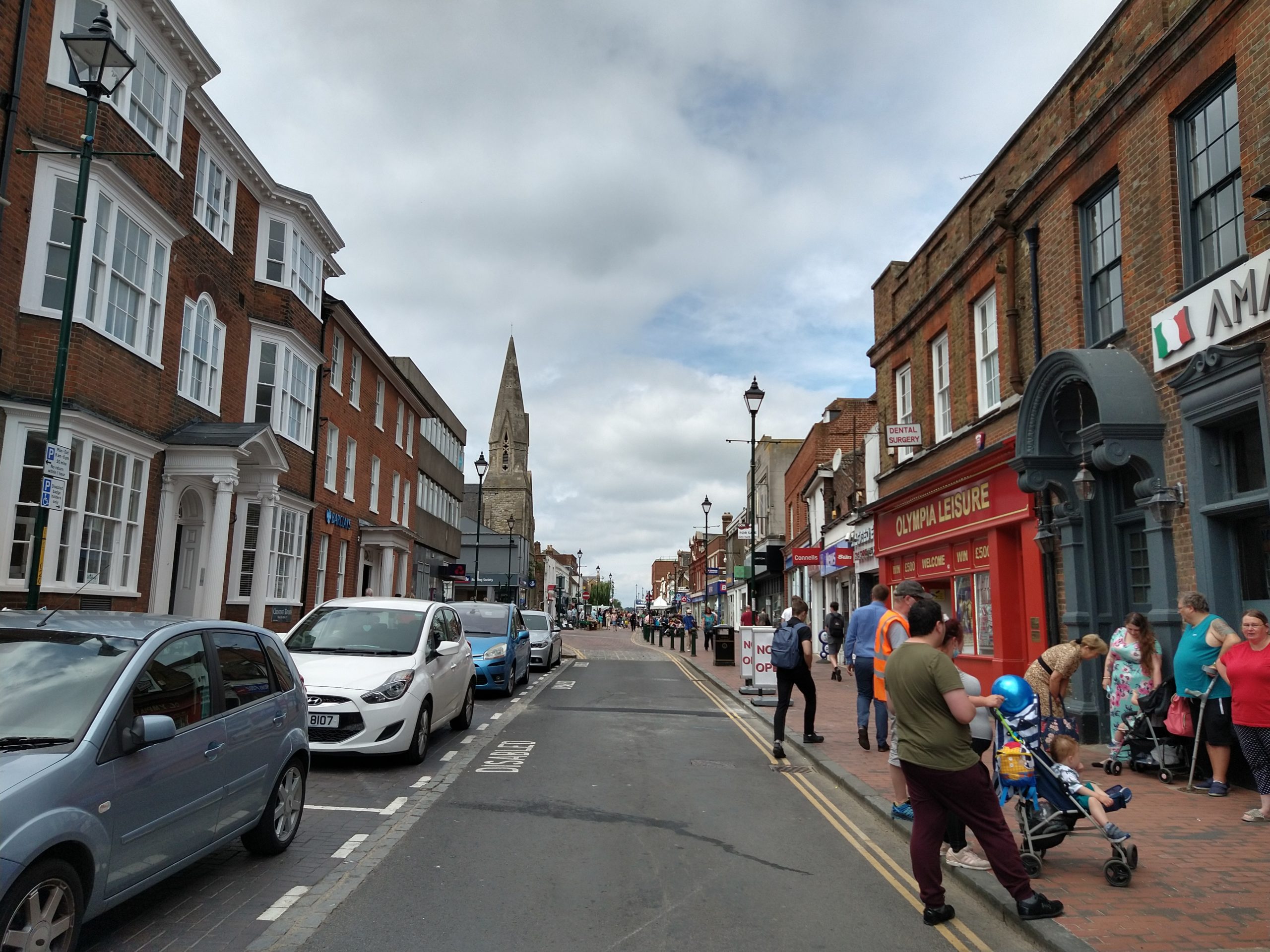
Left: Sittingbourne High Street. Credit: Swale Borough Council
A local character study will be required to develop an understanding of the urban morphology, landscape character and architecture of the locality. Unique design responses will be applied to the site to create a place of character and the elements that have informed the design of the development framework will be identified. The local character study will cover:
•Urban form,
•Block pattern and size,
•Development to space relationships, such as building heights to street widths,
•Open space typologies,
•Built response to topography,
•Heritage,
•Local Landscape Characters at national and Local levels,
•Local habitats and species as well as patterns of vegetation,
•Boundary treatments,
•Architectural vernacular and details.
The local character study will be a stand-alone document and once finalised will not change whilst the development framework is likely to evolve further.
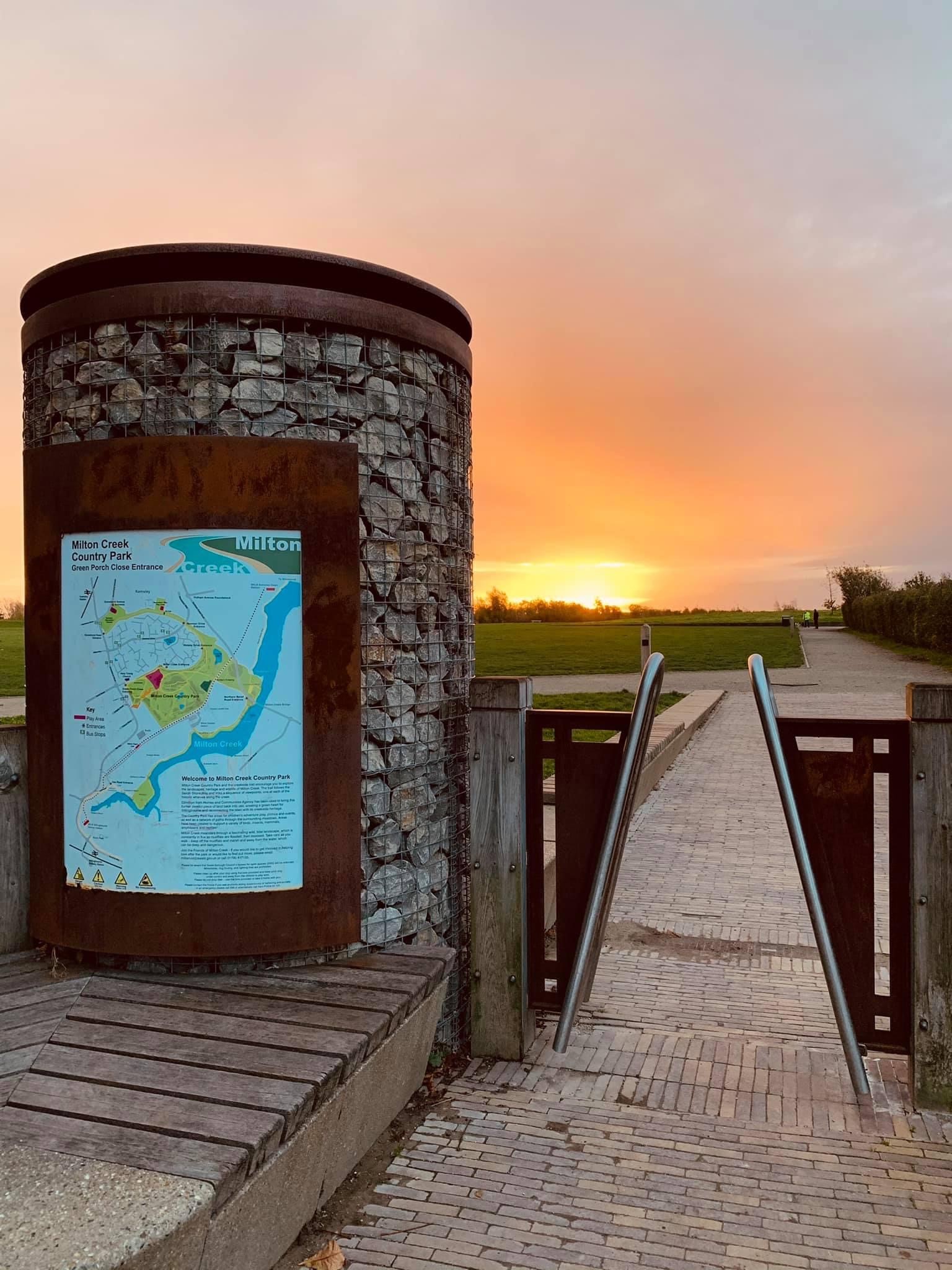
Above: Milton Creek Country Park, Sittingbourne. Credit: Swale Borough Council
Development will be arranged in perimeter blocks with exposed ‘rears’ and ‘sides’ facing the public realm kept to a minimum.
Where there are exposed rears on an adjacent existing site then rears are permitted on a site boundary otherwise only frontage is permitted on site boundaries.
Physical, social and economic ‘landmarks’ will be identified.
In order to achieve the desirable block form densities will be increased.
Focus will be given to walking and cycling connections between neighbourhoods, to social infrastructure and to public transport facilities.
Vehicular connections will be made not only to the distribution network but also to adjacent neighbourhoods with a street hierarchy which will be based on a dispersed approach to vehicular movement. Cul-de-sacs will be avoided.
Future possible vehicular, cycle and pedestrian connections to adjacent sites will not be prejudiced.
Residential car parking will not dominate the public realm and street parking will be provided in bays rather than at the side of the carriageway.
Car ports rather than garages will be encouraged.
Parking courts may be considered if dwellings overlook the space and the space is well designed with good tree cover.
A connected network and variety of multi-functional landscapes and open spaces will be provided. Demonstration will be required of the positive response to:
•Retention of existing woodland, trees and hedgerows, as well as achieving biodiversity net gain
•Green infrastructure
•Contribution to strategic water management
•Climate change mitigation proposals
•A high standard of locally native plant species and trees (of local provenance and supportive of biodiversity) for soft landscape in a pattern which respects the landscape character.
Above: Bourne Place, Sittingbourne. Credit: Swale Borough Council
Public spaces, which include streets, will be well designed and accessible to all to support social interaction.
Street trees, ideally at regular intervals forming a continuous shade canopy over the medium term, will be provided in contribution to the street hierarchy for shade, air quality, water management and to create attractive places.
Active frontage for natural surveillance of all open spaces and streets will be provided for all types of land uses. Entrances to buildings will be prominent, of the correct scale for the number of users and free from clutter. corners/gable ends require treatment to provide visual interest in the street scene using windows and other materials, as a well as ensuring overlooking of the street scene.
High quality robust materials will be used in the public realm.
Private gardens will be located ideally at the rear of a house and will be a minimum of 10.5m in length.
Private front gardens will be a minimum of 50% soft landscape to contribute to flood risk reduction, green infrastructure, bio-diversity and positive design facing the public realm.
Communal gardens for houses may be provided in addition to private gardens and in which case the minimum private garden size may be foregone.
For two-or-more-bedroom flats communal residents’ gardens will be provided on the basis of a minimum area of 25m² per flat. They will be screened by above-eye-level walls or hedges from the public realm and will contain a sitting-out-area that receives sunshine during at least part of the day. Unusable strips of space between car parks or roads and buildings will not be counted as part of the communal garden provision.
For town centre blocks of flats and one-bedroomed flats where there is access to good local open space or access to a green roof terrace or balconies the provision may be foregone.
Above: Regent Quay, Sittingbourne. Credit: Swale Borough Council
Development will include or provide clear connections with a mix of uses with including local services and facilities to support daily life. Schools will be located in conjunction with local retail facilities.
Affordable housing will be provided and will not be placed in the ‘worst’ parts of the site.
Authentic architectural design will be required and high-quality materials that are local will be expected.
New buildings should be “of their time” unless the characteristics of an area require a traditional approach.
Generic volume house types should be avoided.
The proportion for window openings is often similar to the proportion of the building facade itself: a tall, narrow building will have tall, narrow windows; a building that is more square in facade proportion will have windows that are more square.
The exterior of the building will not be cluttered with utilities; utility boxes will ideally not face the public realm and will blend with the building materials.
Where porches are provided they will be integrated in the building design and not just ‘tacked-on’ elements.
Attention to detail will be paid to entrances to blocks of flats with a doorway to match the scale of the building and number of occupants and well as to avoid a clutter of different elements attached to the exterior face.
The details of operation and servicing will be worked out so as not to defeat the intent of the design of the building. Storage and servicing of waste will be addressed positively and will not negatively impact on the street scene.
Buildings will be designed to be adaptable to respond to changing lifestyles, demographics and advances in sustainability technology.
Above: Faversham Lakes, Faversham. Credit: Swale Borough Council
Layout, form and mix of uses will reduce resource requirements.
Good quality facing and roof materials will be selected from the range of regional materials characteristic of Swale ideally sourced locally to minimise distance travelled.
Opportunities for including sustainable design and construction techniques will be maximised including the use of recycled and recyclable materials, sustainable drainage systems, carbon reduction and minimising waste.
In particular, buildings will be designed with passive solar design and fabric first principles.
Stewardship, delivering successful, large-scale developments requires a clear understanding of how the assets generated by them will be managed in perpetuity. Community assets such as parks and community centres are vital elements of high-quality, attractive places, but their long-term management arrangements must be considered from the outset.
Consideration should be given to all opportunities for asset management, engagement with existing community groups and parish/town councils, taking a staged approach to allow for due diligence and community engagement, funding streams, entrepreneurial opportunities, and how good design can make the process easier (for example through the multi-use of community buildings). Consideration should also be given to how dialogue with the local community will be maintained to understand what they want as the community evolves over time. Done well, and by putting local people at its heart, the process can generate increased local support, creativity and entrepreneurialism.
Places, spaces and buildings will be designed for longevity.
Left: Milton Creek Country Park, Sittingbourne. Credit: Swale Borough Council
Boundaries
Attention will be paid to boundary detailing using local referencing, natural materials and appropriate treatments. Particular attention will be given to boundaries facing the public realm. Front boundaries will be low, transparent or semi-transparent of hard or soft landscape. Rear and side boundaries will not face the public realm but where this is unavoidable sturdy materials such as brick or stone walls will be provided and close-board timber will be avoided.
The majority of a secure boundary of institutions such as schools will be provided by dwellings.
Boundaries to open spaces will be open and permeable.
Acoustic barriers will be avoided in favour of moving buildings from the noise source, but where absolutely necessary they will be of natural materials and be associated with planting such as trees, hedgerows and climbers.